



Will a VR Fishing Rod fit Quest Pro Touch Controllers well enough for relaxing VR sessions?

I love relaxing VR games, but holding a bare controller for VR fishing feels wrong. I wanted more immersion, so I bought a VR fishing rod accessory for my Quest Pro controllers.
Yes, a VR fishing rod generally fits Quest Pro Touch Controllers well enough for casual, relaxing sessions. But the fit is not perfect. This can lead to minor wrist discomfort after about 30 minutes of continuous play because the controller’s shape creates a slight, unnatural angle.
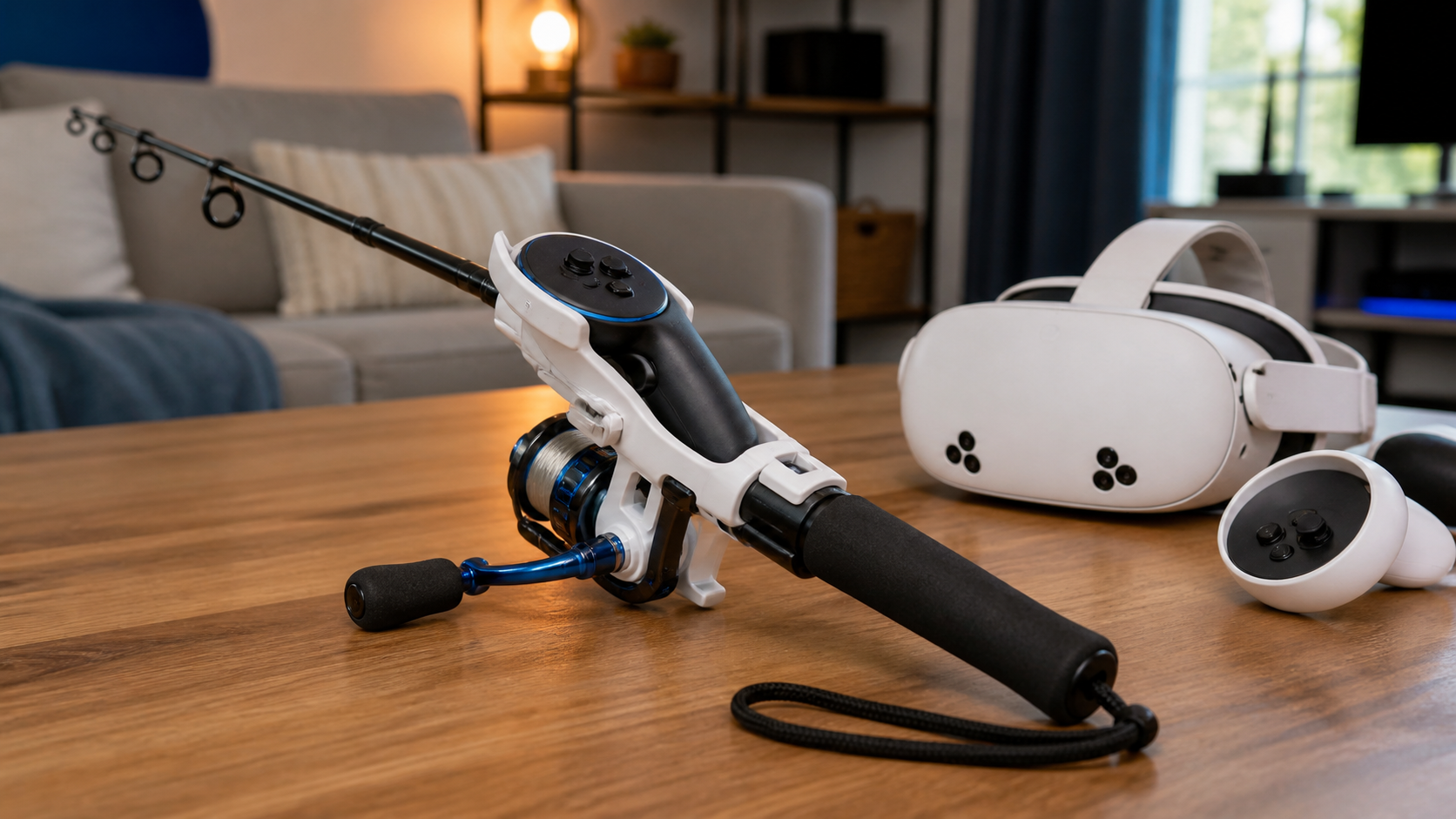
I use my Quest 3 with Quest Pro Touch Controllers because I love the tracking and balance. Finding accessories that fit them perfectly can be a challenge. Most products are designed for the standard Quest 2 or 3 controllers. When I saw a fishing rod attachment, I was excited but also skeptical. Fishing games are my go-to for winding down after a long day. I often play for 30 minutes to an hour, just sitting on my couch. The idea was to make these sessions feel more real. But I knew that if the fit wasn't right, it would create more problems than it solved. This is my experience after spending a week testing if this accessory could truly upgrade my virtual fishing trips or if it was just another piece of plastic destined for a storage bin.
Is wrist comfort still a problem after adjusting left-handed orientation and button access?
My left-handed setup always adds a little challenge. I need to flip orientations and make sure I can still reach every button. But something still felt slightly off with this rod.
Yes, even after adjusting for left-handed use and ensuring all buttons were accessible, a subtle wrist comfort issue remained. The core problem is that the Quest Pro controller's ergonomic curve doesn't sit perfectly flush inside a mount designed for a straighter controller body, forcing an awkward wrist angle.
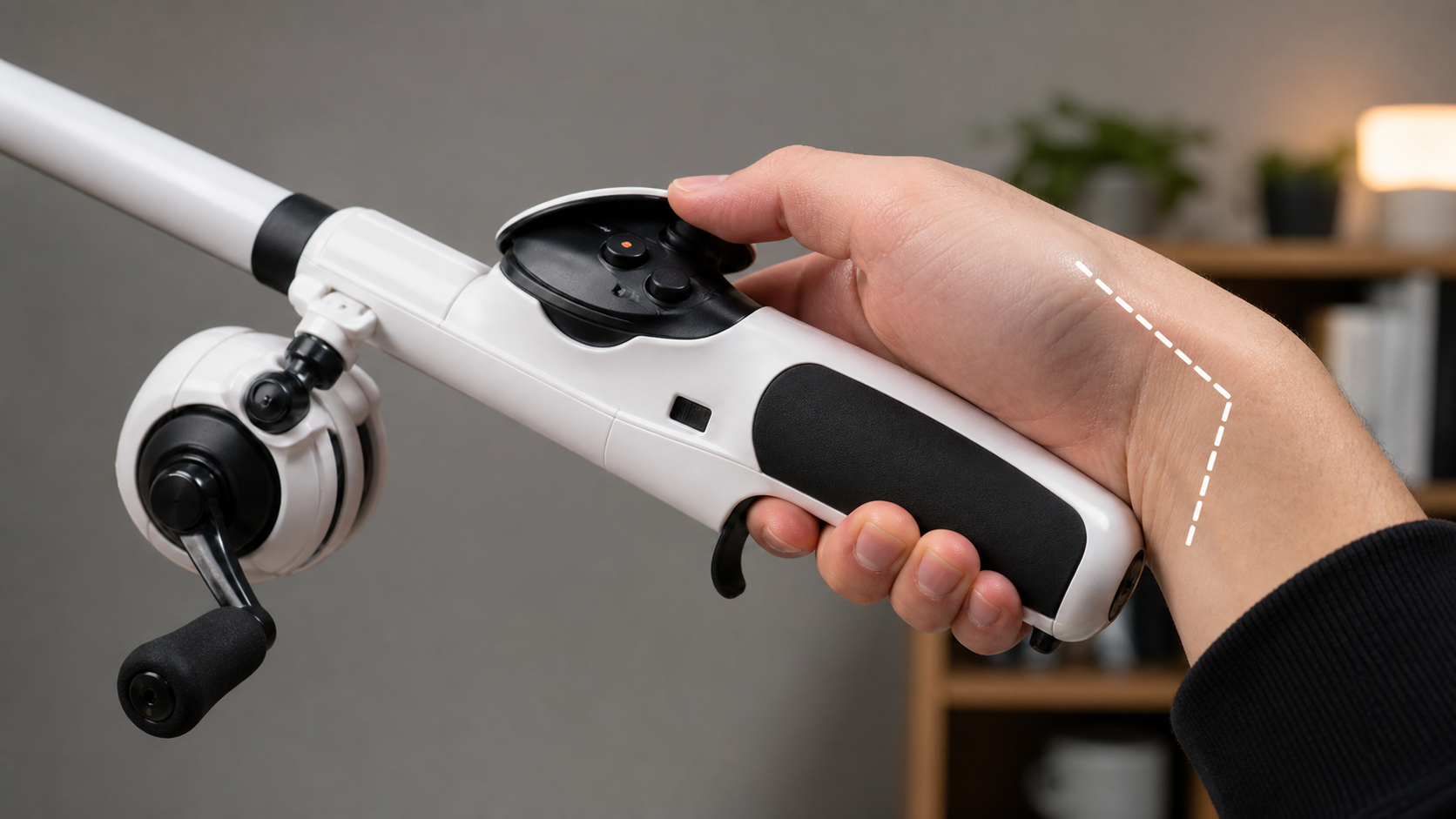
The initial setup was simple. The mount uses a secure latch system, and I could easily insert the Quest Pro controller. I switched the reel handle to the other side for my left-handed preference. At first, everything seemed fine. The controller was locked in, and I could access the trigger and grip buttons without any trouble. The issue wasn't about access, but about alignment. The Quest Pro controller has a distinct curve that the Quest 2 and 3 controllers lack. This accessory's internal mold was clearly generic. Because of this mismatch, the controller sat at a slight angle inside the housing. This forced my wrist to bend a few degrees sideways to compensate and keep the virtual rod straight. It’s a tiny difference, but over time, that small, constant strain is noticeable.
Controller Fit vs. Wrist Alignment
| Factor | Observation with Quest Pro Controller | Impact on Comfort |
|---|---|---|
| Mount Shape | Designed for a straighter controller body. | Creates a small gap and slight rotation. |
| Controller Angle | Sits slightly twisted in the mount. | Forces the wrist into an unnatural position. |
| Button Access | Trigger and grip are fine. Thumbstick is a reach. | Less impact on fishing, but noticeable. |
Can the writer show the exact moment wrist comfort appears in relaxing VR sessions?
You feel great for the first 20 minutes. You are casting, reeling in fish, and enjoying the immersion. Then, a faint ache starts to creep into your wrist and forearm.
Yes, the discomfort reliably appears around the 30-minute mark during a seated, relaxed play session. It’s not a sharp pain, but a gradual, dull ache that starts in the wrist and radiates up the forearm. It begins right after a series of quick casting and reeling actions.
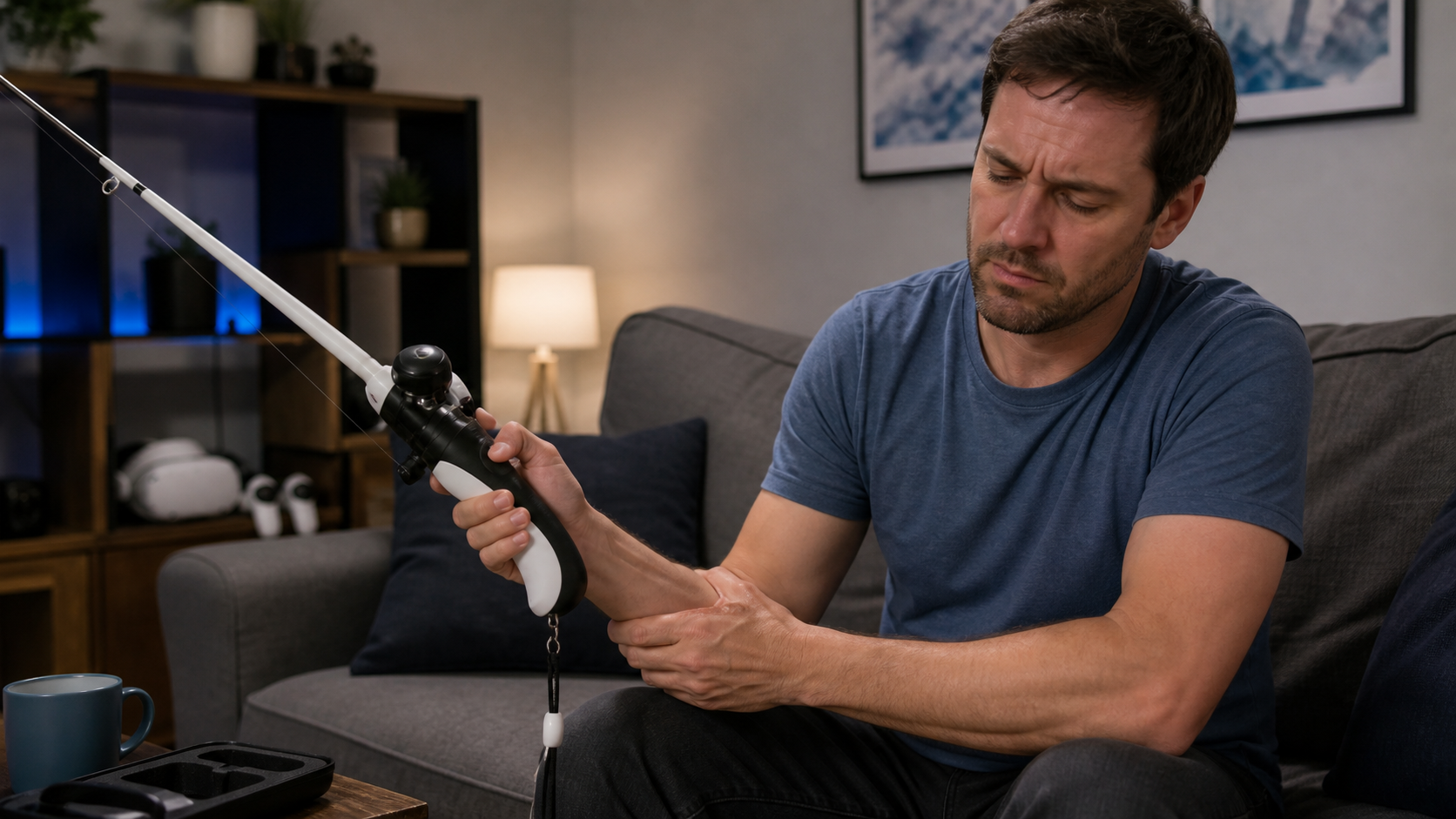
To test this, I sat down for a dedicated session in Real VR Fishing. I set a timer and decided to just play normally without thinking too much about the accessory. For the first 15 to 20 minutes, I was completely absorbed. The rod felt great. The weight and length added a new level of realism. The haptic feedback from a bite traveled down the plastic rod, which was a cool effect. Then, I hooked a larger fish that required more frantic reeling. After I landed it, I went to cast again and noticed my wrist felt tired. I checked my timer: 28 minutes. The strain came from fighting the awkward angle. When I was just holding the rod steady, it was fine. But the repetitive motions of casting and reeling amplified the poor ergonomic fit, fatiguing the small muscles in my wrist and forearm. It was the exact opposite of the relaxing experience I was looking for.
Can photos prove the fit issue better than a paragraph of explanation?
It’s hard to describe a subtle gap or a slight angle. Words like "minor" and "slightly" don't capture the real feeling. A picture can show the problem instantly.
Absolutely. A side-by-side photo comparison can immediately show the gap between the Quest Pro controller and the rod’s housing. It makes the source of the awkward wrist angle obvious in a way that a paragraph of text struggles to convey, turning an abstract complaint into a visible design flaw.
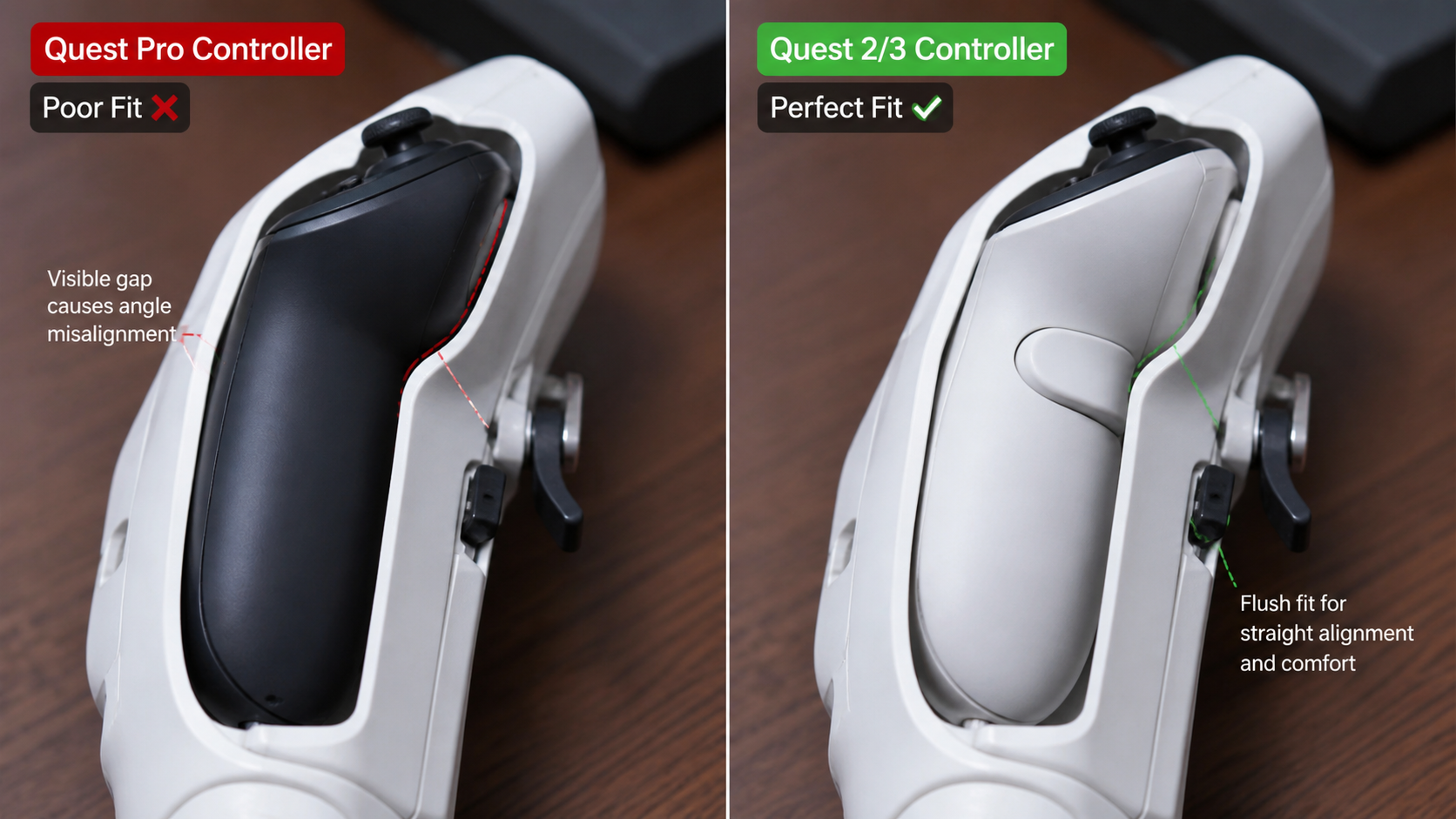
When you try to explain the problem, it sounds like you are just being picky. "The controller doesn't sit completely flush." It doesn't sound like a big deal. But when you see it, you get it. I took a few photos of the Quest Pro controller in the mount from different angles. One photo from the top down clearly shows the controller’s body pushing against one side of the plastic mold, leaving a visible gap on the other. Another photo from the side shows how the controller’s handle is tilted slightly upward instead of being parallel with the rod itself. This is the tilt that forces your hand into that uncomfortable position. Compared to a photo of a standard Quest 2 controller sitting perfectly inside the same mount, the issue is undeniable. The visual proof is more powerful than any description I could write. It shows that this is not a user error; it is a compatibility issue baked into the design.
Would the same VR Fishing Rod recommendation still hold after a week of relaxing VR sessions on Quest Pro Touch Controllers?
First impressions can be misleading. Sometimes you get used to a product's quirks, and other times they become more and more annoying. I needed a week to decide.
No, my initial recommendation would change. After a week, the rod is not an everyday accessory. The wrist discomfort makes it unsuitable for my typical 30-minute casual sessions. However, I still keep it for longer, more immersive weekend sessions where the added realism outweighs the ergonomic flaw for a while.
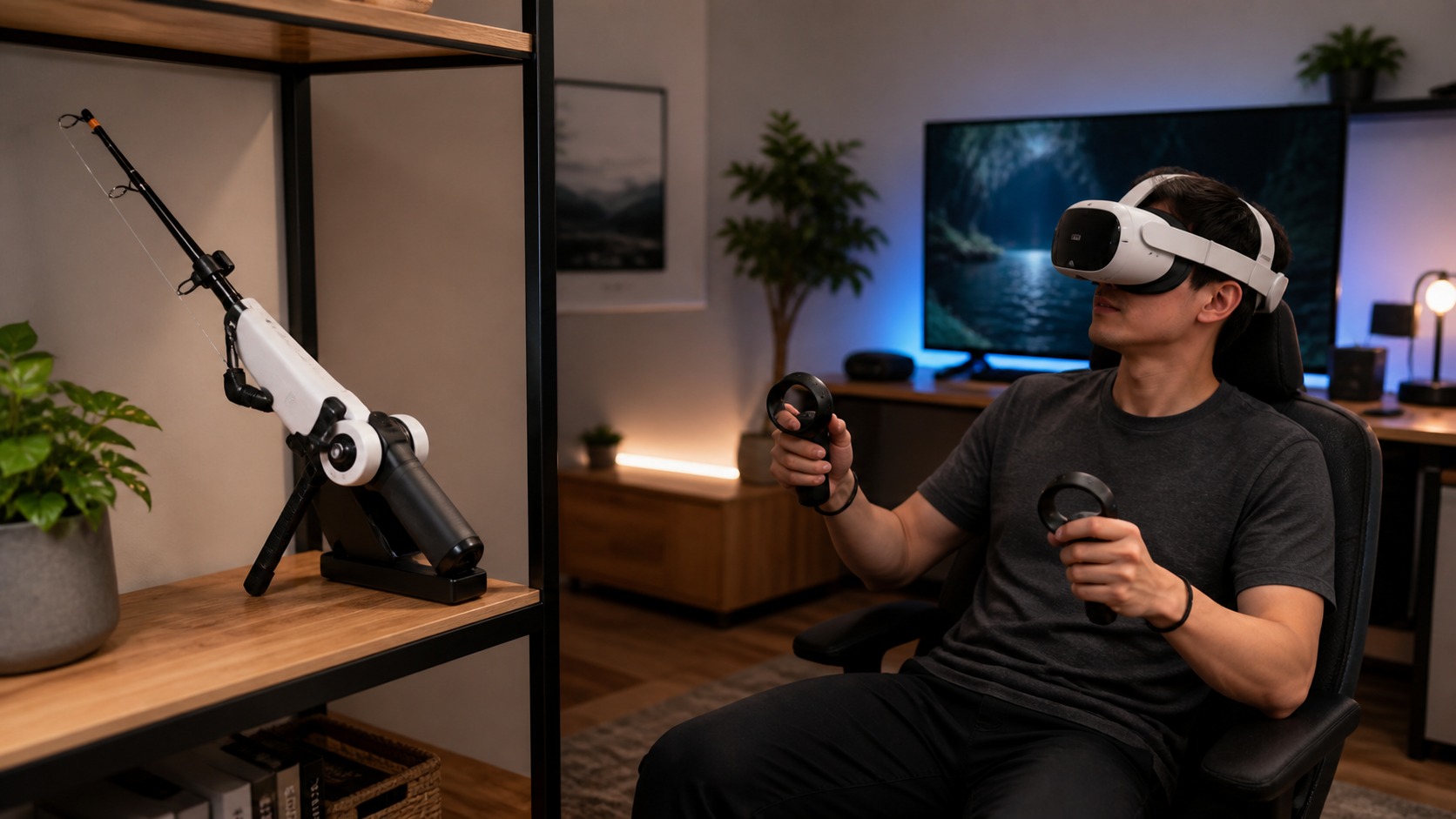
During the week, my usage patterns told the real story. On weekdays, when I just wanted to jump in for a quick, relaxing 20-minute session, I didn't even bother with the rod. The hassle of clipping the controller in and the knowledge that my wrist would soon feel tired made me stick with the bare controller. The bare controller isn't as immersive, but it's zero-friction and perfectly comfortable. However, on Saturday, when I had more time, I pulled the rod out again. The novelty and added immersion were still enjoyable for the first half hour. So, my final verdict became more nuanced. I can't recommend it as a must-have for every Quest Pro owner who loves fishing games. But for the dedicated virtual angler who wants maximum immersion for special sessions and can tolerate the comfort trade-off, it has its place. For casual drop-in players, I’d say skip it. The bare controller is better for pure relaxation.
Conclusion
The rod adds immersion but subtracts comfort for Quest Pro controllers. It's great for short, serious sessions but poor for long, casual relaxation. For many, the bare controller is better.
Leave a comment