



Is default grip versus claw grip expectations the hidden reason Beat Saber Grips disappoints buyers for Expert+ Players?

You're trying to perfect that Expert+ map, but your score just won't budge. You know the pattern, but your swings feel inconsistent. Is it your grip slipping mid-song?
For Expert+ players, the main issue isn't comfort; it's the subtle "grip transition" that ruins a perfect run. These controller shifts, caused by default grips or even claw grip, destroy the repeatable angles needed for high scores. Beat Saber Grips are designed to solve this specific control problem.
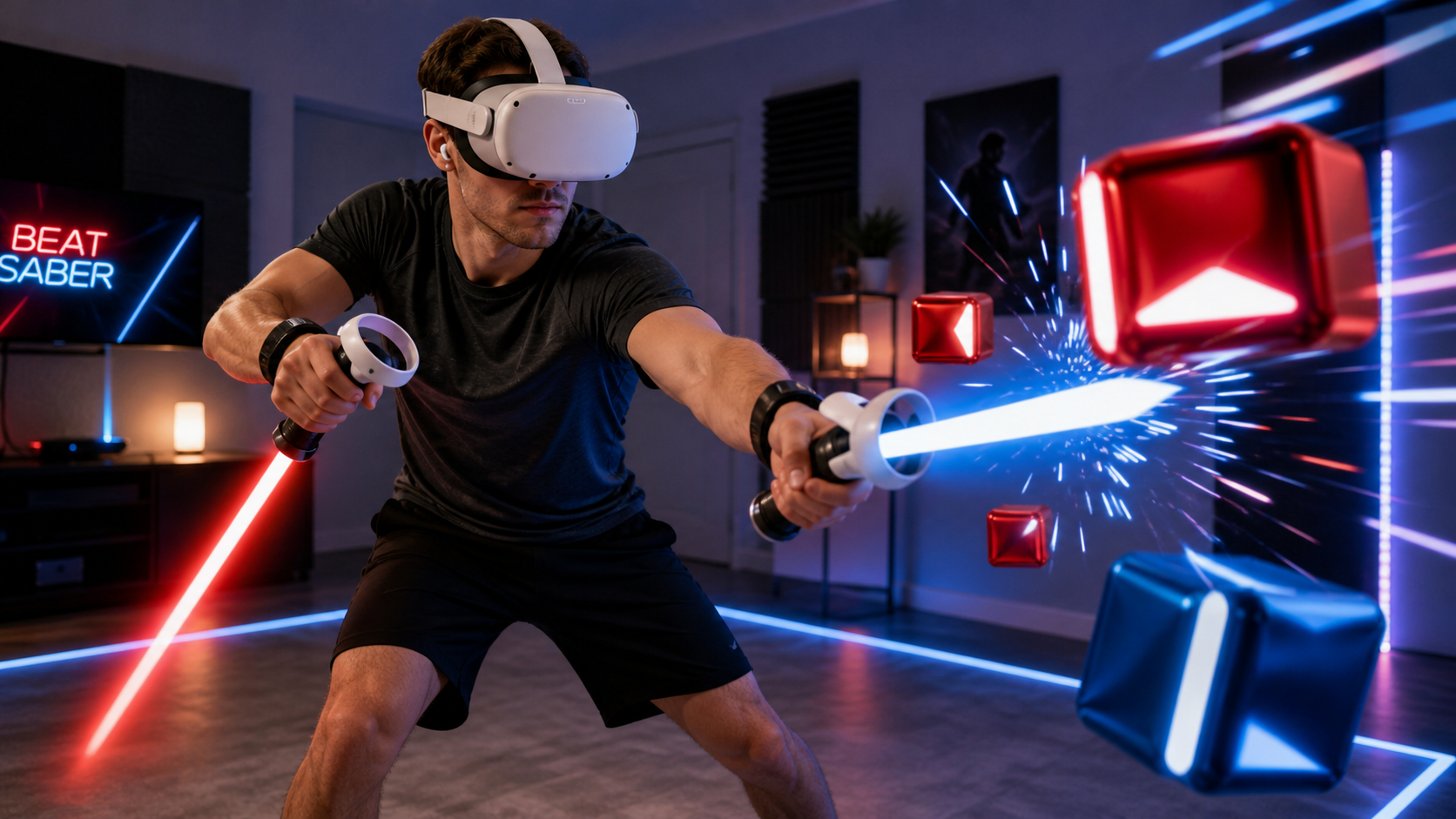
I've spent hundreds of hours in ranked Beat Saber play, and I hit a wall. My scores plateaued, and I couldn't figure out why. I watched my replays and realized my saber angles were slightly off during fast, cross-body sections. My controller was moving in my hand, just a tiny bit, but it was enough to turn a perfect cut into a bad one. I heard about Beat Saber grips and wondered if they were just another gimmick or if they could solve this specific, high-level problem. This isn't a review about comfort for beginners. This is my deep dive into whether these accessories actually help a competitive player get better, based on my own experience climbing the leaderboards. Let's break down the real questions that matter.
Would Expert+ players notice grip transition in ranked play before they notice comfort or setup?
You miss a block on a map you’ve cleared a dozen times. You blame yourself, but what if your controller shifted just a millimeter? That tiny change is the real enemy.
Yes, absolutely. An Expert+ player's performance is built on muscle memory. We feel a slight grip transition instantly as a failed cut or a low-scoring hit. This in-game frustration is far more noticeable and important than the one-time hassle of setup or long-term general comfort.
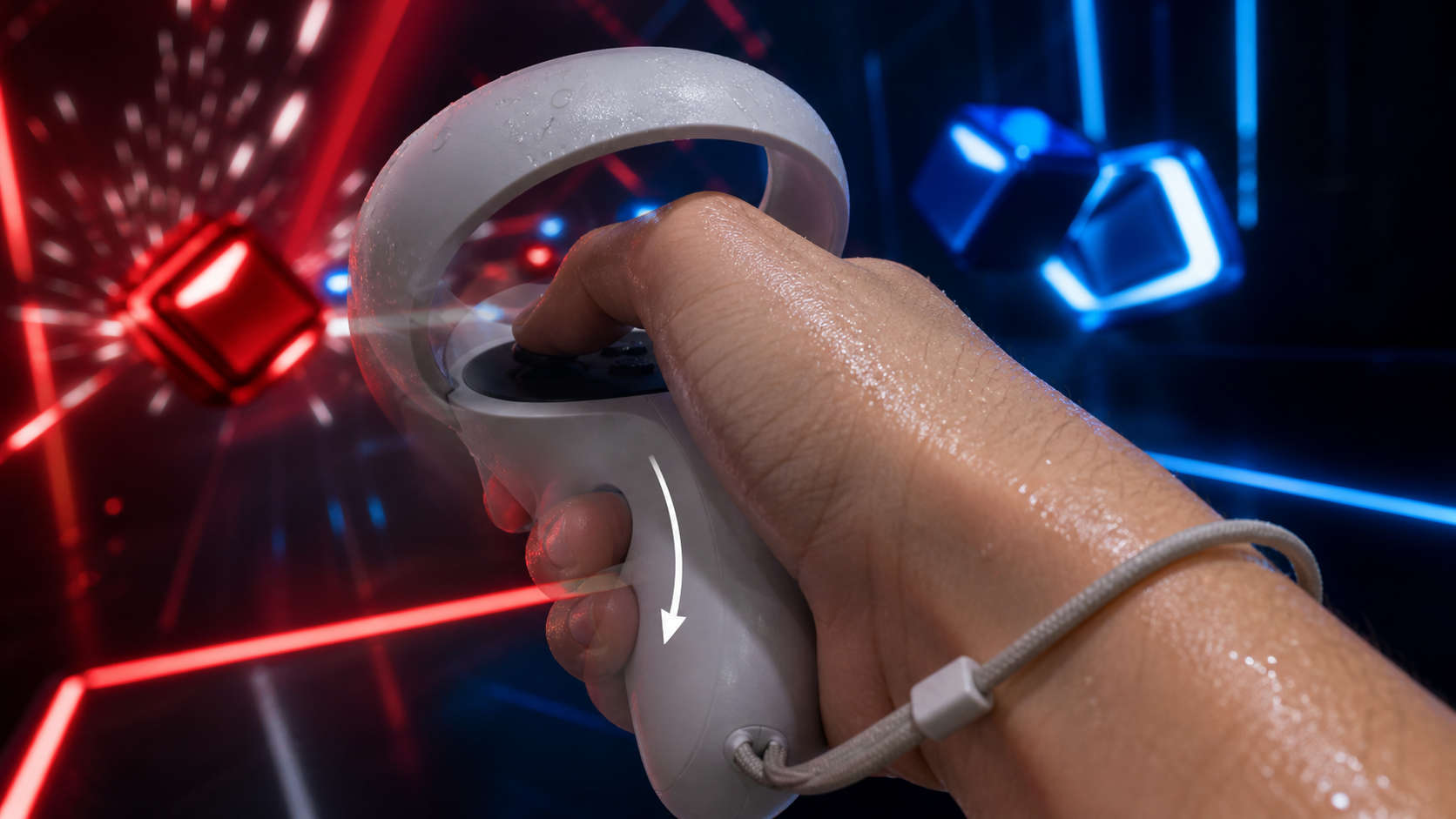
For a casual player, comfort is king. If the controller feels bad after 30 minutes, that's the biggest problem. But when you're chasing a full combo on a 9-star map, comfort is the last thing on your mind. Your entire focus is on execution. A "grip transition" is when the controller rotates or slides in your palm during a swing. It might only be a few millimeters, but that changes the angle of your saber. This means a swing that your brain knows is perfect results in a 70-point slice instead of a 115. It's infuriating, and it happens constantly with the default wrist straps during intense sequences. I noticed this problem long before I ever felt like my hands were sore. The setup for a new accessory is a five-minute issue. Grip transition is a constant, score-killing problem.
Comfort vs. Control Breakdown
The priority for players changes dramatically with skill level. A beginner wants something that feels good to hold. An expert wants something that does exactly what they tell it to, every single time.
Player Priority Comparison
| Factor | Expert+ Player's Perspective | Casual Player's Perspective |
|---|---|---|
| Grip Transition | Immediate score loss. Ruins muscle memory and consistency. The highest priority to fix. | Barely noticeable. They might just think they made a bad swing. Low priority. |
| Comfort | Important for long sessions, but secondary to performance. I'll take a less comfortable grip if it's more stable. | The most important factor. If it's not comfortable, they won't play for long. |
| Initial Setup | A one-time inconvenience. I'll spend 10 minutes setting something up if it gives me a performance edge. | Can be a barrier. If it's too complicated, they might not even use the accessory. |
Does Meta Quest 2 compatibility change the answer for this Beat Saber Grips question?
The Quest 2 controllers are great, but they feel small and slick. Add some sweat from a tough song, and you have a recipe for disaster. This is where grips become necessary.
Yes, the design of the Meta Quest 2 controllers makes grip transition a much bigger problem. Their small size, smooth plastic, and simple wrist strap make them easy to rotate during the fast wrist flicks needed for Expert+ songs. A dedicated grip accessory becomes almost essential to lock them in place.
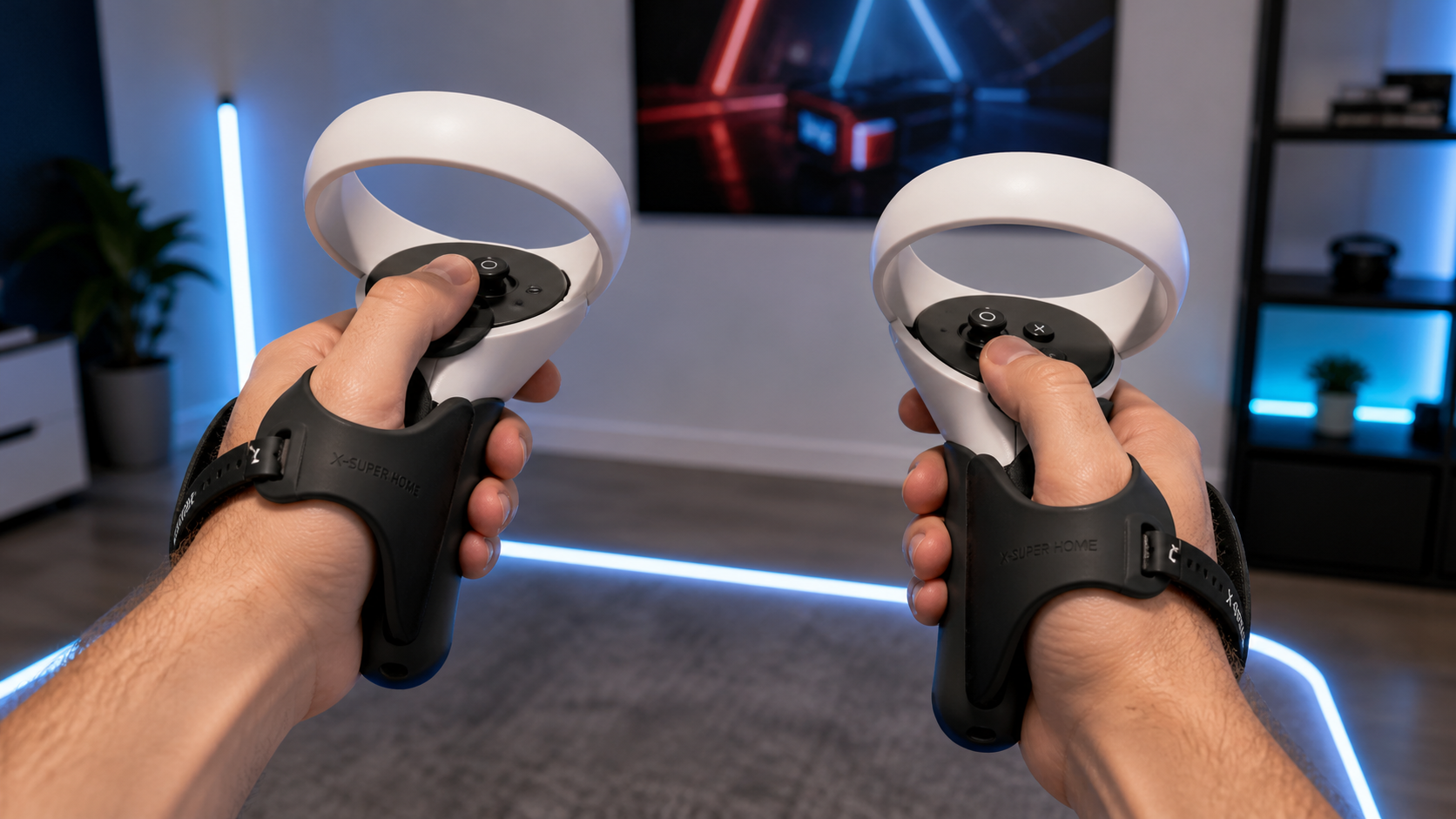
I've used several VR systems, and the Quest 2 controllers are uniquely challenging for high-level Beat Saber. They are lightweight and ergonomic for general use, but they lack the heft and shape to stay put during rapid, repetitive motions. The battery cover is notoriously slippery, and I've even had it slide open mid-song, which is an instant combo breaker. Default "claw" grips help a bit, but they can cause hand strain, and you still don't get a perfect, locked-in feel.
A good grip accessory for the Quest 2 does two things. First, it uses a knuckle strap to secure the controller to your hand, so you can relax your grip without fear of it flying away. This alone reduces fatigue. Second, it often adds length and a better gripping surface, changing the controller's center of balance to feel more like a real saber hilt. This leverage makes it much harder for the controller to twist unexpectedly. For the Quest 2, these grips aren't just a comfort upgrade; they are a fundamental control fix.
Does the title need a warning for people with small rooms or shared spaces?
You bought long grips to feel like a Jedi. Now you are a danger to your furniture, pets, and family. The extra length is not a joke, and you need more space.
Yes, a big warning is necessary. Saber-style grip extensions add several inches to your reach. This significantly increases the size of your required playspace. If you have a small room, you will hit walls, furniture, or people. Safety must come first, so measure your space carefully.
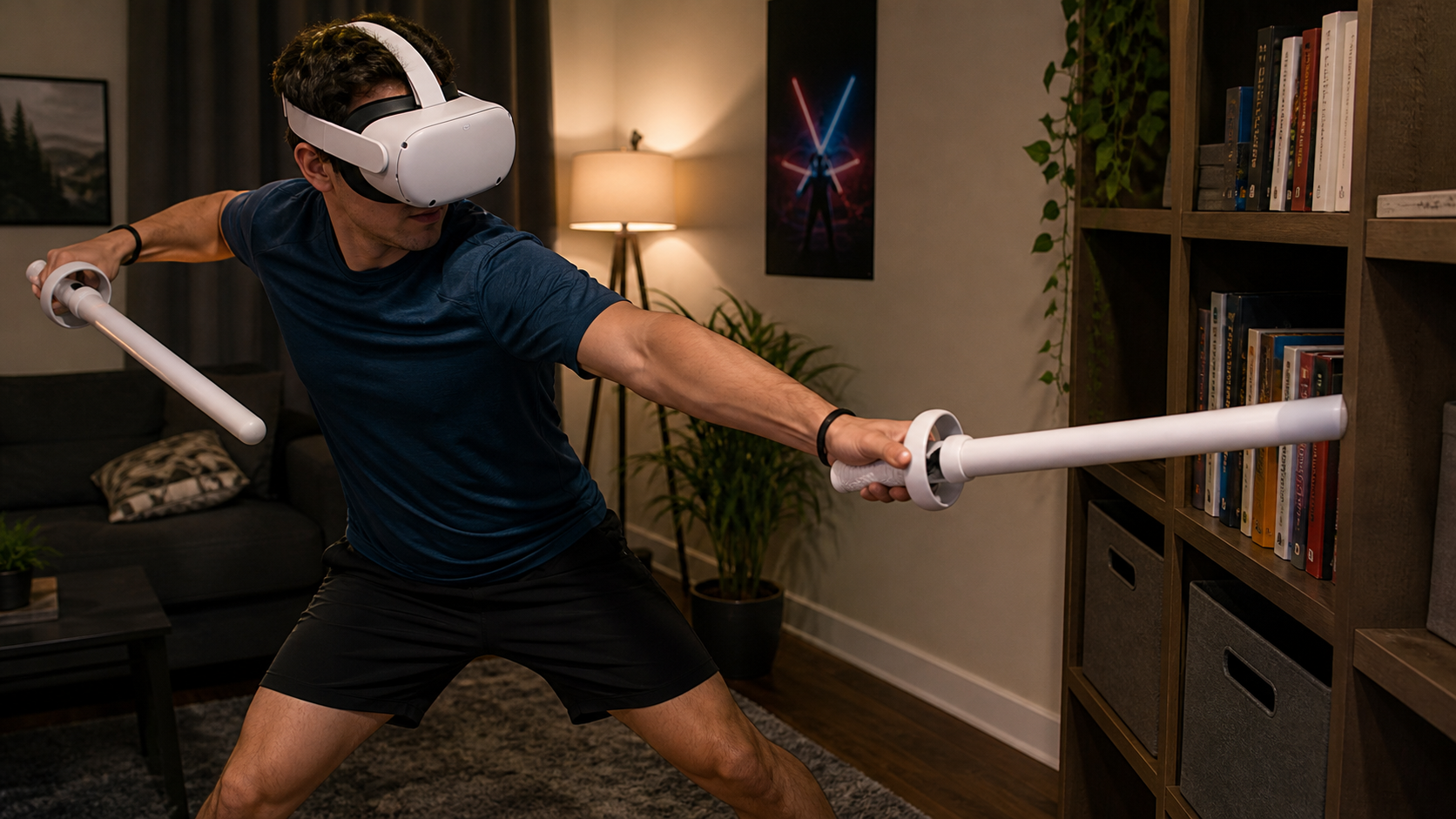
I learned this the hard way. The first time I used a set of longer grips, I was deep into a fast song. I did a wide, cross-body swing and heard a loud thwack. I had completely misjudged my distance and smacked the edge of my desk. Thankfully, nothing broke, but it was a serious wake-up call. The grips extend your virtual hands, but your brain is still calibrated to your physical arms. It takes time to adjust.
Before you even think about buying saber-style grips, you need to assess your playspace. Put them on your controllers and stand in the center of your room. Slowly extend your arms fully in every direction—up, down, left, and right. If you can touch anything, your space is too small. You need to redraw your Guardian boundary to be much more conservative, leaving at least an extra foot of buffer space between you and any obstacle. If you share your space, make sure everyone knows to stay far away when you're playing. Knuckle straps without the long extensions are a safer alternative for smaller rooms.
Does Beat Saber Grips solve enough of grip transition in ranked play to justify another accessory?
Are these grips really worth your money? You've already invested in a headset and games. It depends entirely on what kind of player you are and what you want from the game.
For a competitive Expert+ player, yes, the grips are absolutely worth it. They provide the stability needed to eliminate grip transition, leading to higher accuracy and better scores. For a casual or fitness player, probably not. The standard controller is good enough, and the cost and setup are unnecessary.
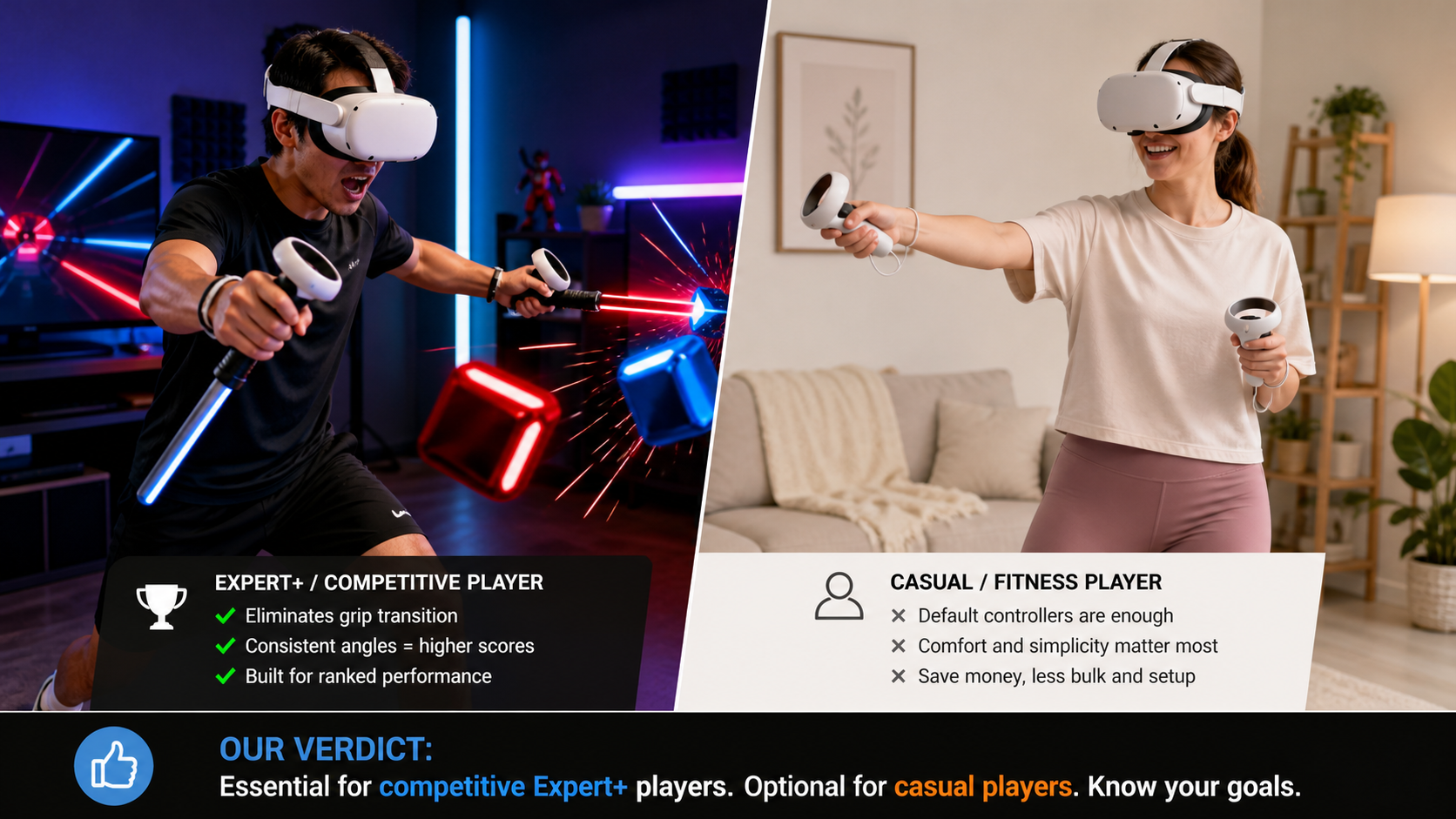
This is where I have to be completely honest. These grips are not a magic solution that will instantly make you a top-100 player. There is an adjustment period. The new weight and balance will feel weird at first, and your scores might even drop for a day or two. But if you stick with it, the benefit becomes clear. The consistency is the key. Swing after swing, the saber is in the exact same position relative to your hand. My accuracy on fast streams improved dramatically because I could finally trust my muscle memory.
The Final Verdict
For players who live on the ranked leaderboards and analyze their replays to find tiny errors, a good set of grips is a vital piece of equipment. It solves the single most frustrating hardware problem in high-level play.
Who Should Buy and Who Should Skip?
But if you play Beat Saber to get a good workout, listen to music, and have fun, you should save your money. The default controllers and wrist straps are perfectly fine. The grips add weight, make the controllers bulkier, and require you to strap in and out every time you play. For a casual user, these are just annoying downsides with no real upside. This is a tool for a specialist, not a necessary upgrade for everyone.
Conclusion
Beat Saber grips are a fantastic tool for Expert+ players who need to eliminate grip transition for higher scores. Casual players should skip them. Always check your room space before buying.
Leave a comment