



Do Quest Pro Touch Controllers users need a different VR Sword setup for small rooms?

Playing VR melee games in a small room is tough. Your wrists ache from short, flicking motions. A VR sword accessory seems like the perfect fix for my Quest Pro controllers.
For Quest Pro users in small rooms, a VR sword accessory can help by shifting the controller's balance, encouraging arm swings over wrist flicks. However, it's not a universal fix for wrist fatigue and can even worsen it in fast-paced games, making it a game-specific solution.
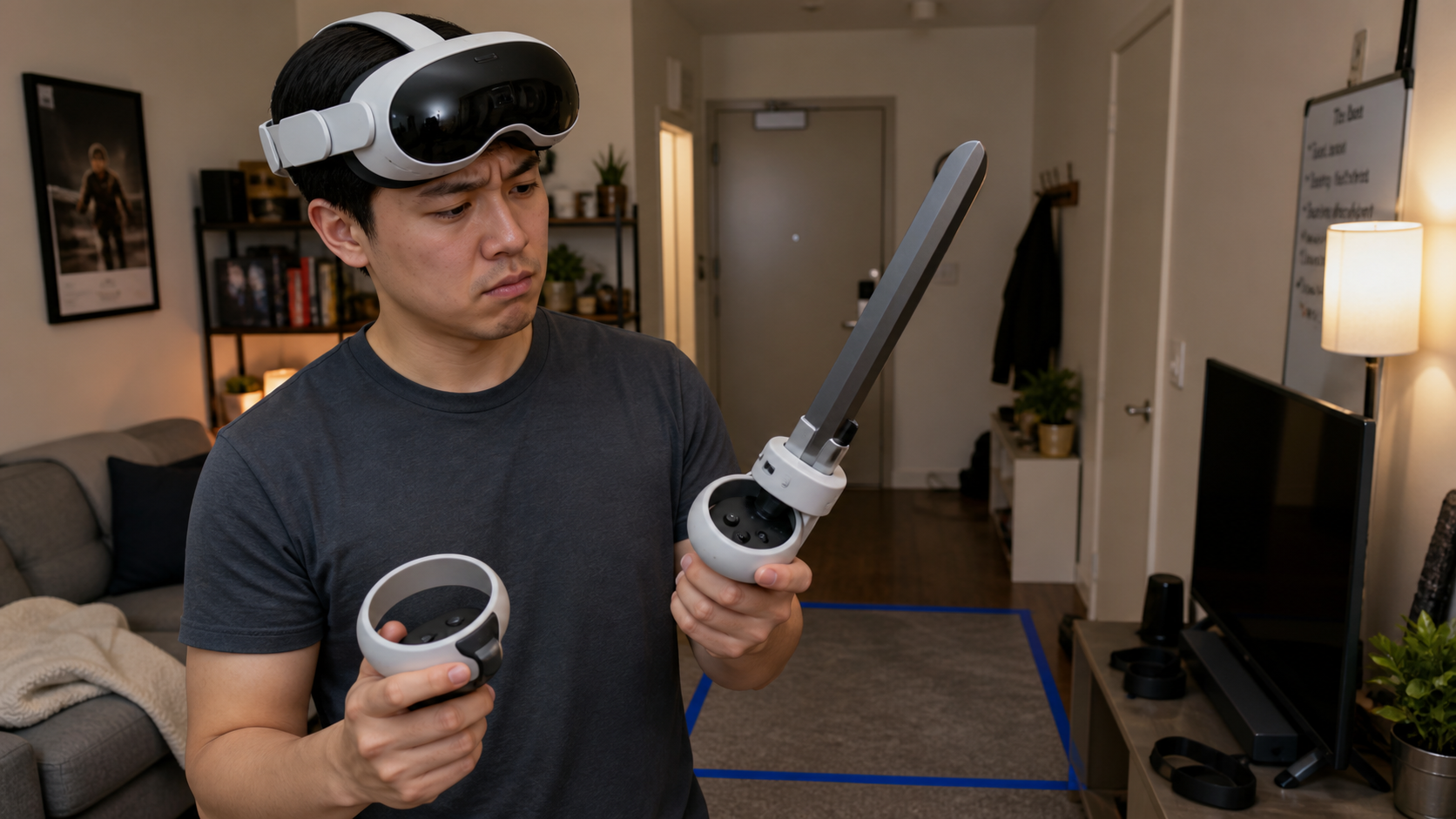
I love sword-fighting games, but my small apartment playspace is a real challenge. I can't do big, sweeping motions without hitting a wall or my desk. This forces me to rely on quick, repetitive wrist movements, which leaves me with a sore, tired feeling after about 30 minutes. I saw these VR sword attachments online and thought they might solve my problem. The idea is that they add a handle, making the controller feel more like a real sword. I decided to buy one and treat this as a personal case study. I wanted to know if this accessory was just a novelty or a real solution for someone like me, a melee fan stuck in a small room. I was determined to find out where it helped, where it failed, and if it was worth the hassle of taking it on and off.
Can a real small rooms clip prove whether wrist fatigue improves?
You see ads with players swinging VR swords in huge, empty rooms. That's not my reality. A video from my cramped space should show if anything actually changes.
A clip from a small room can show how your swing style changes, like using more arm movement. But it cannot prove wrist fatigue is better. Fatigue is a feeling inside your wrist, and a camera can't see or measure that subjective pain.
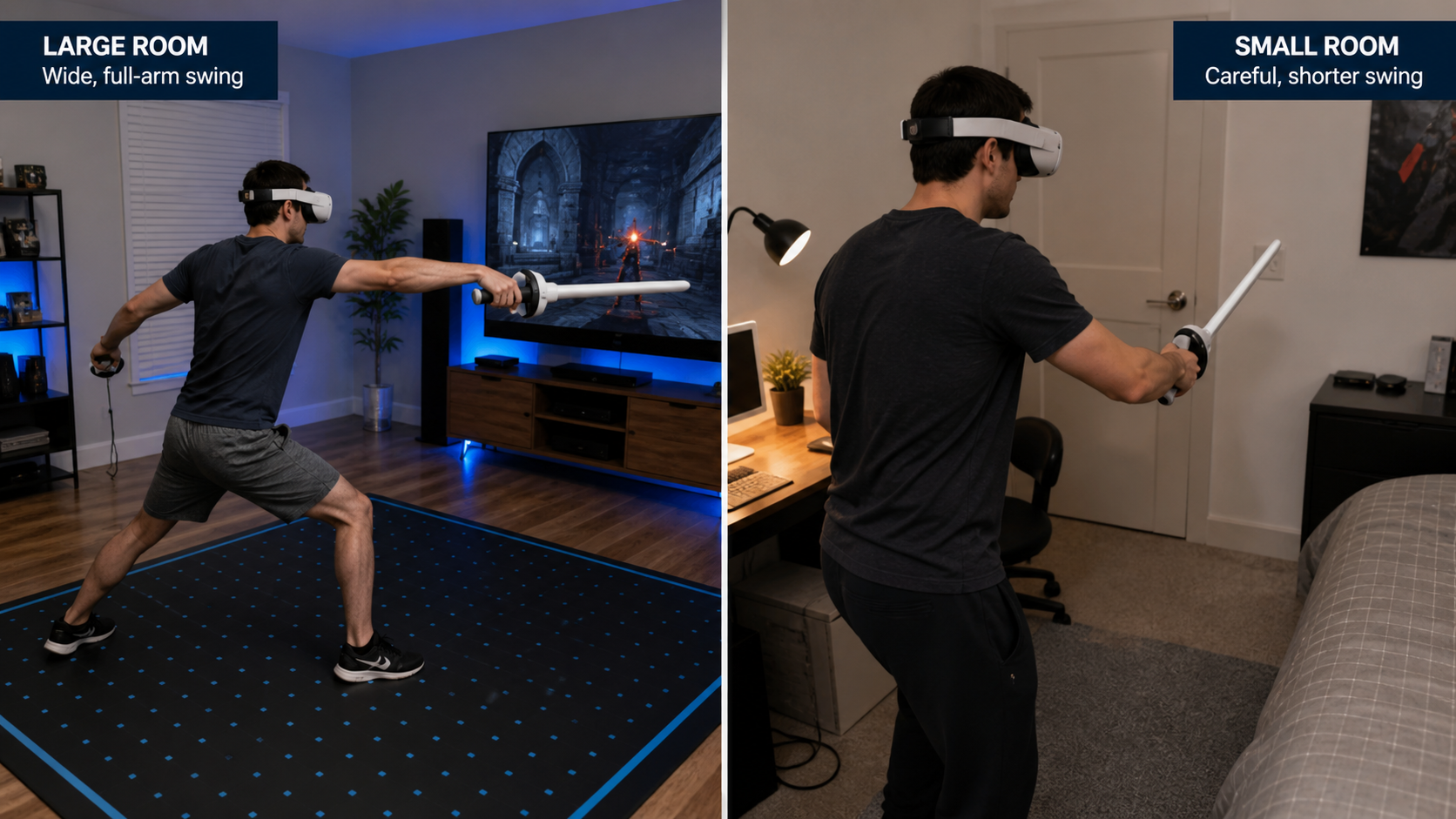
A video is useful, but it only tells part of the story. I decided to record myself playing a few rounds of Blade & Sorcery to see what I could learn. My first recording was with the bare Quest Pro controllers. I watched it back and saw exactly what I expected: lots of quick, snappy wrist flicks. My arm was mostly stationary while my wrist did all the work. Then, I attached the VR sword accessory and recorded another session. The difference on camera was clear. The extra length and weight forced me to use more of my arm and shoulder. My swings were slower and more deliberate. It looked like a big improvement. But what the video didn't show was how my wrist felt. The accessory changed the balance, and while I was using my arm more, the leverage of the longer handle was putting a different kind of strain on my wrist.
What a Clip Shows vs. What It Hides
A video provides visual data, but it misses the physical experience entirely. Here is what I found.
| What a Clip Can Show | What a Clip Can't Show |
|---|---|
| Changes in swing arc and speed. | The feeling of tendon strain. |
| Hesitation near furniture or walls. | The exact moment fatigue begins. |
| A shift from wrist to arm movement. | The sensation of weight imbalance. |
| Visible adjustments in grip. | The specific muscles being stressed. |
So while my gameplay clip looked more "realistic" with the sword attachment, it didn't tell me if it was solving the root problem. I needed a better way to measure the actual fatigue.
What should be measured before claiming VR Sword fixes wrist fatigue?
Brands claim their accessories fix everything, but they never show proof. You need real data. To know if it truly helps, you have to measure the right things.
To properly test if a VR sword accessory reduces wrist fatigue, you need to track specific metrics. Measure how long you can play before pain starts and rate that pain on a scale. Compare these numbers with and without the accessory.
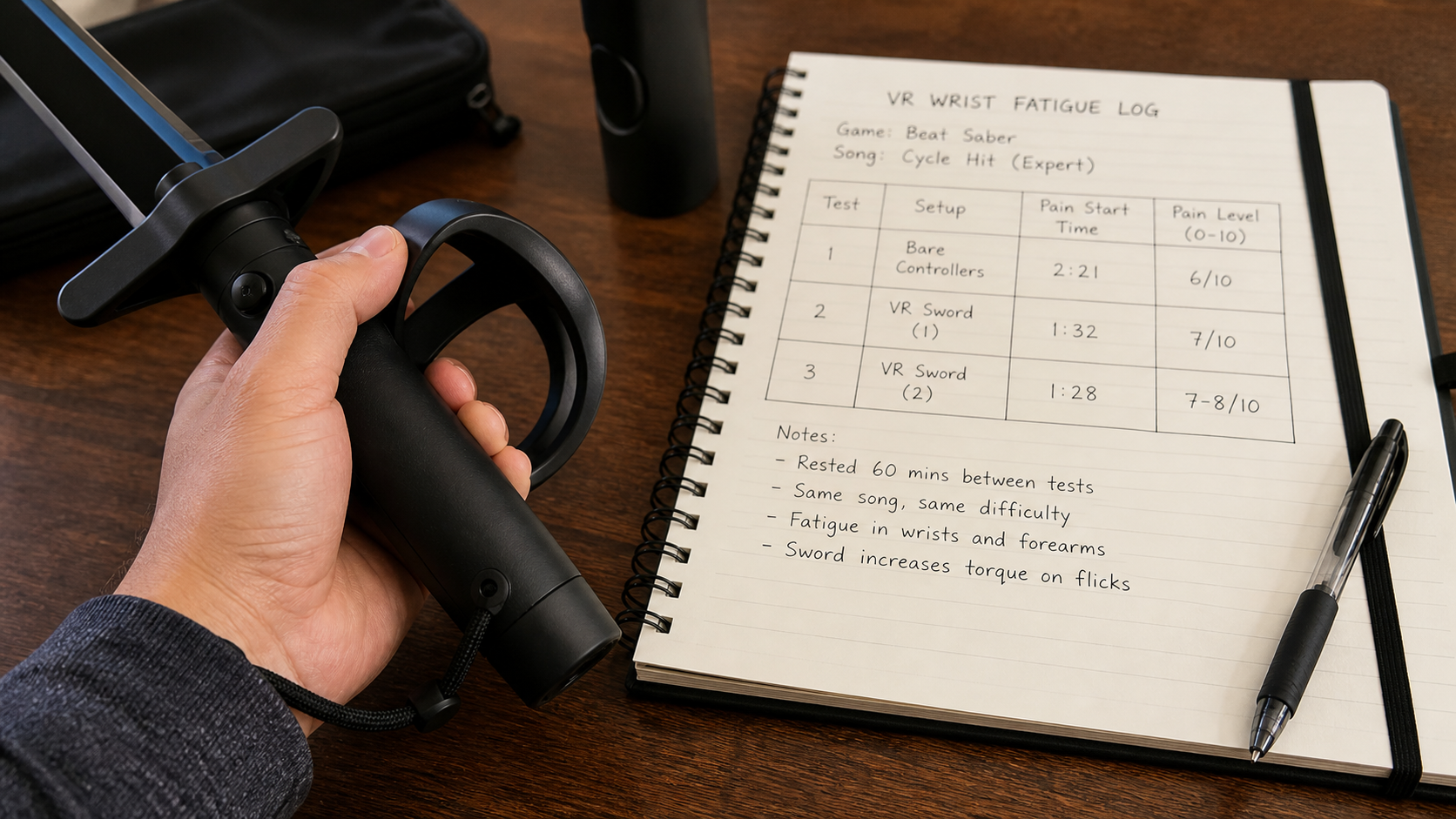
I realized I had to be more scientific. I needed a repeatable test. I chose a game that consistently gives me wrist fatigue: Beat Saber. I picked one specific song, "Cycle Hit" on Expert difficulty. I know this song inside and out, so I can play it consistently every time. My test was simple. First, I played the song with my bare Quest Pro controllers and took a note of exactly when my wrists started to burn. It was about two-thirds of the way through the song. I rested for an hour to make sure my wrists were fully recovered. Then, I attached the VR sword accessories and played the same song again.
This is where I found the failure case. With the sword handles attached, my wrist fatigue was significantly worse. It started less than halfway through the song. The extra weight and length were terrible for the fast, precise wrist flicks Beat Saber demands. The accessory shifted the center of gravity forward, away from my hand. This created more torque on my wrist with every swing. For a game that is 100% about wrist action, the accessory was a complete failure. It proved that for certain games, these attachments can make the problem much worse. In slower games like Asgard's Wrath 2, where swings are powerful and deliberate, it felt better. But for fast rhythm games, it's a no-go.
Does the accessory still feel good after sweat, heat, or fast motion?
A new accessory feels great for the first ten minutes. But what happens when you're in an intense battle, sweating and moving fast? That's the real test of comfort.
No, the feel can change dramatically. Sweat makes smooth plastic grips very slippery, forcing you to hold on tighter. This extra tension, combined with the added weight during fast motion, can increase fatigue and make the accessory feel clumsy and unstable.
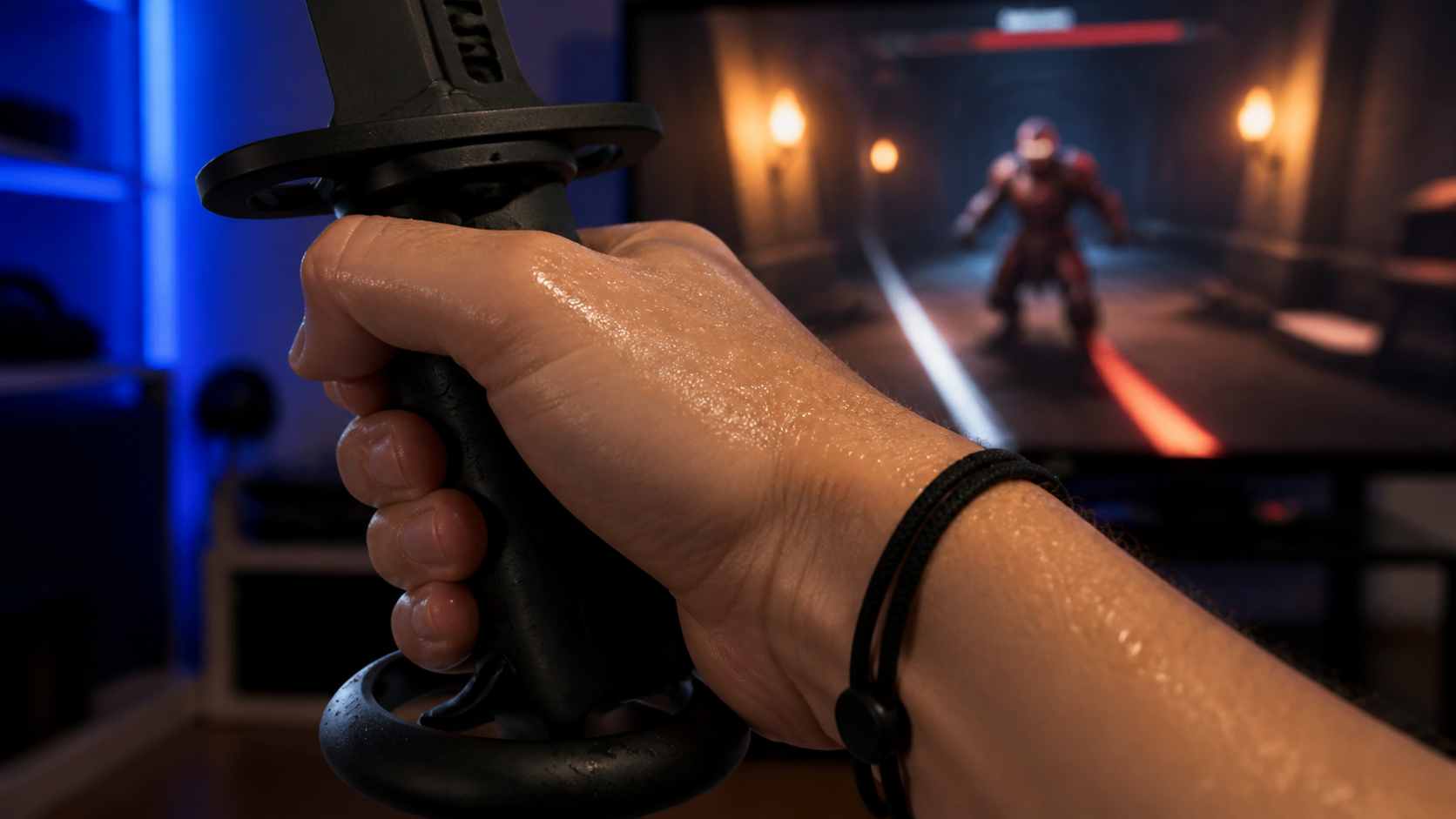
To test this, I jumped into a long session of Until You Fall. This game is a workout, and it involves a lot of fast blocking, dodging, and attacking. After about 15 minutes, my hands started to sweat. The hard plastic of the sword handle, which felt fine when I started, became slick. I found myself having to grip much harder to keep the controller from slipping, especially when I had to parry a quick attack. This extra gripping force went straight to my forearm and wrist, adding a new layer of fatigue. The standard Quest Pro controller has a much better, grippier texture that handles sweat well.
The accessory also trapped more heat around my hand than the bare controller. It wasn't a huge deal, but it was another small comfort issue that added up over time. During very fast movements, the added momentum was noticeable. The weight at the end of the handle wanted to keep going, and I had to fight it to change direction for a block. It felt like the accessory was working against me, making me less agile. In a small room, where you can't use footwork to dodge, this instability in your hands is a major problem. It made me feel less in control, which is the opposite of what an accessory should do.
Should the recommendation differ for casual and daily small rooms use when wrist fatigue appears?
Wrist fatigue is a real problem. You might wonder if you should just ditch an accessory. The right choice depends entirely on how much and how often you play.
Yes, the recommendation is completely different. A casual user playing for an hour a week might love the immersion. A daily user needs to prioritize long-term wrist health. For them, any accessory that adds consistent strain is a bad idea.
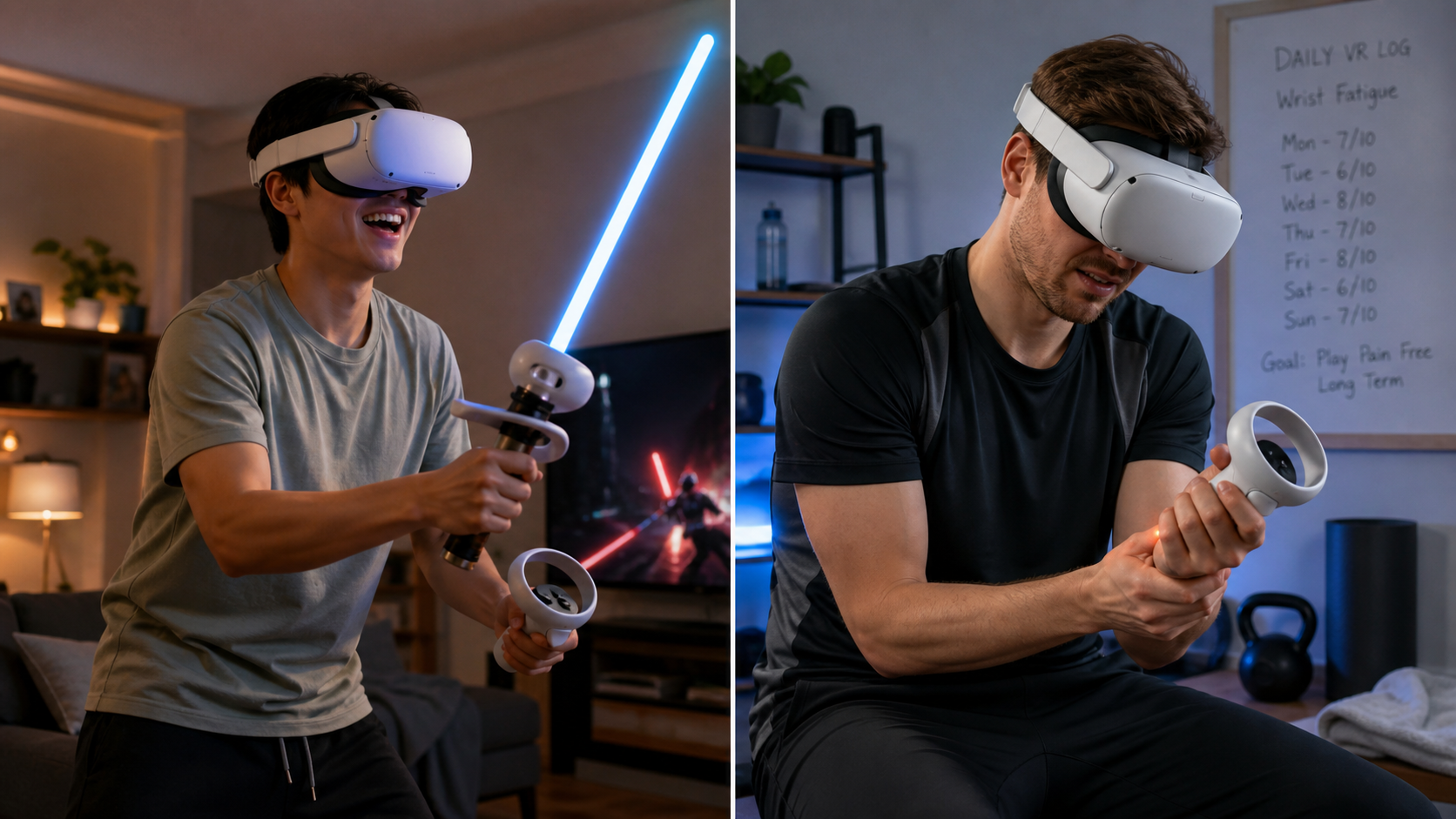
After all my testing, my opinion on the VR sword accessory is split. It really comes down to the type of user you are.
For the Casual User
If you play VR once a week to experience a game like Vader Immortal or a slow-paced adventure, this accessory is fantastic. The added weight and length make you feel like you're holding a real lightsaber or sword. The immersion is a huge plus. Since you're not playing for hours every day, the minor wrist fatigue you might feel isn't a long-term risk. The hassle of attaching and removing the accessory for a single play session is also not a big deal. For this type of player, the "wow" factor outweighs the ergonomic downsides.
For the Daily User
If you're like me and you play melee games almost every day in a small space, the calculation changes. Long-term comfort and wrist health are the most important things. This accessory, while fun, introduces variables that can lead to repetitive strain. The added setup time becomes a daily chore. More importantly, if it increases fatigue in any of your main games, it's actively harming your ability to play. For daily use, the bare Quest Pro controller is simply a better ergonomic tool. I've stopped using the sword attachment for my daily sessions. I only bring it out for specific, slow-paced experiences where immersion is the only goal.
Conclusion
This VR sword can boost immersion for casual players. But for daily small-room gamers with wrist fatigue, the bare Quest Pro controller is the safer and more comfortable choice.
Leave a comment