



Can a VR Gunstock solve gun angle calibration for Meta Quest 2 owners without extra settings?

Tired of constantly tweaking gun angles in VR shooters? You spend more time in settings than in the game, and your aim still feels off, costing you matches.
A VR gunstock can solve gun angle calibration issues without extra settings by providing a consistent physical anchor for your hands. This forces the in-game weapon to align with a real-world object, creating stable, repeatable muscle memory for aiming, especially for Meta Quest 2 users.
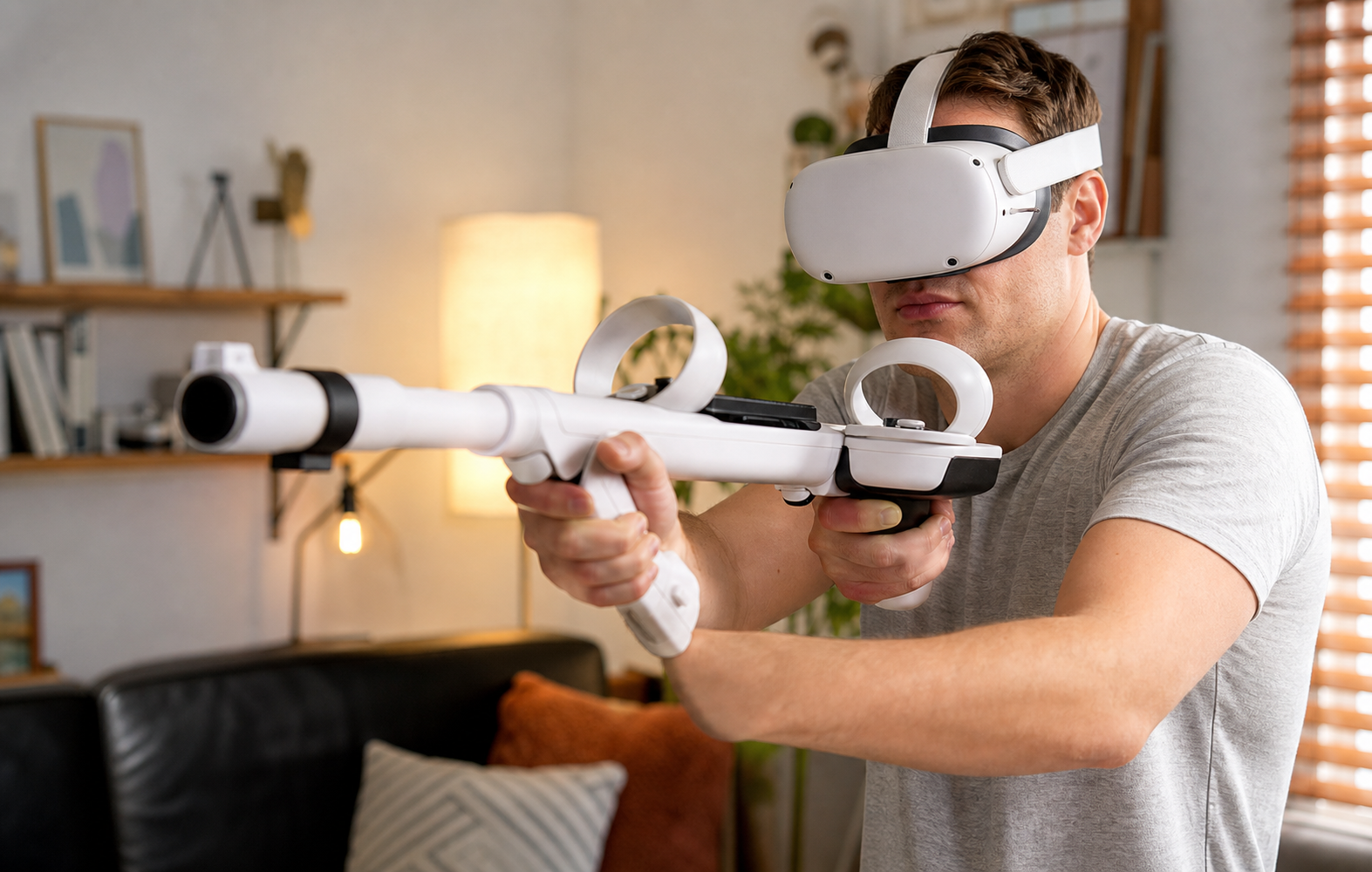
As a left-handed player, I've always struggled with the default weapon setups in tactical VR shooters. The digital gun never felt quite right, and I'd waste the first few minutes of every session trying to find that perfect angle in the game's settings. It's frustrating when you know your aim is good, but the tool feels wrong. I decided to see if a physical gunstock could fix this problem for good, forcing the game to adapt to me, not the other way around. I wanted to know if this physical accessory could finally end my calibration nightmare on the Quest 2. This is what I found.
Would left-handed players describe the tactical VR shooters change as comfort, control, safety, or immersion when gun angle calibration changes?
Your hands feel like they are floating in space. You can't get a steady shot because there is no physical feedback, and your aim drifts, making you an easy target.
For left-handed players, the change is all about control and immersion. A gunstock gives you a solid frame to brace against. This makes your aim much steadier and connects your physical actions directly to the game, making the experience feel more real and responsive.
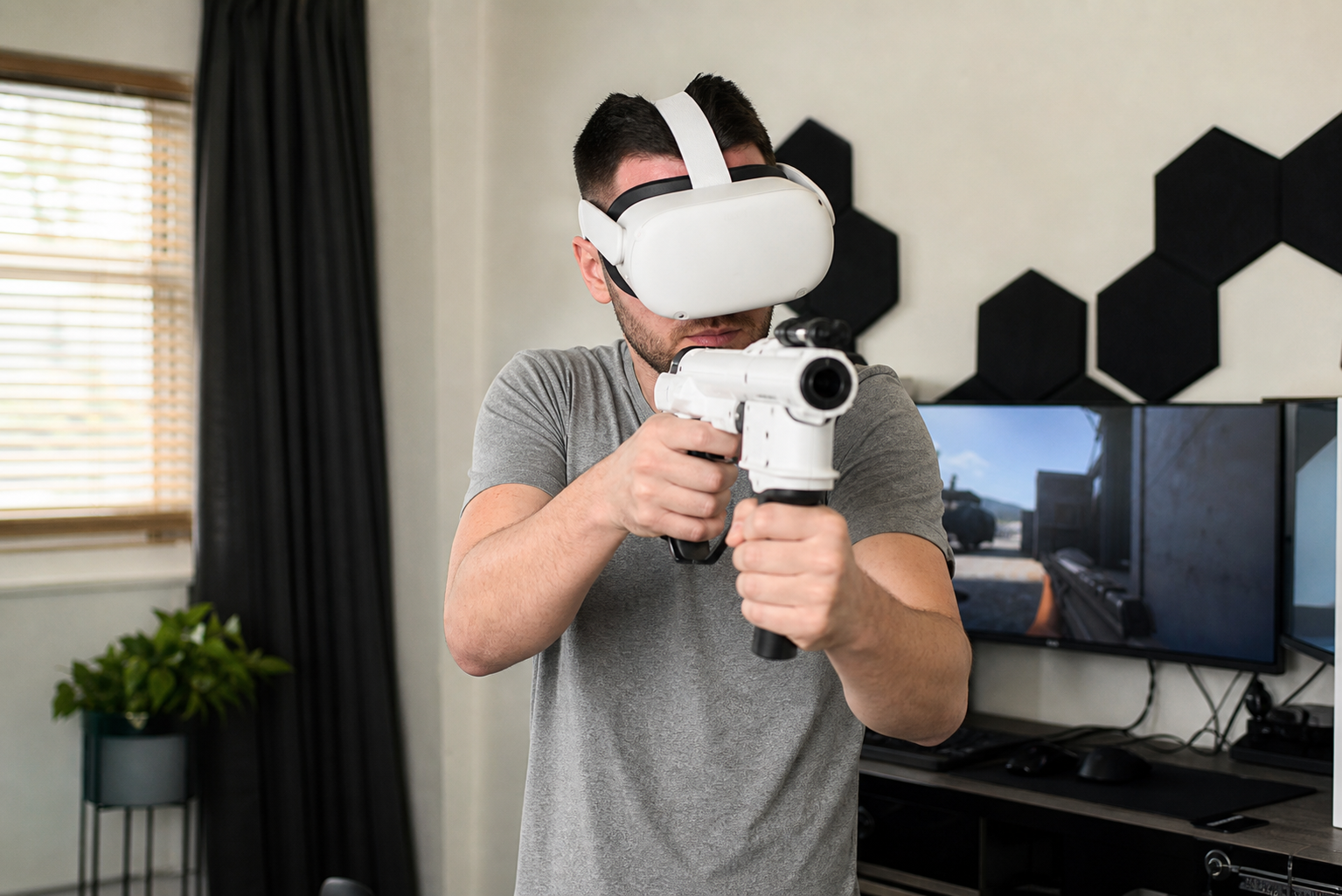
Before using a gunstock, my experience was a constant fight for control. My left hand, the one guiding the barrel, never knew exactly where to be. This instability meant my shots were inconsistent. The moment I clipped my Quest 2 controllers into the stock, that changed. The primary benefit wasn't comfort; some stocks can be awkward to hold. It wasn't safety, though I suppose I’m less likely to punch a wall. It was the immediate, undeniable sense of control. The stock provided two solid connection points, just like a real rifle. My muscle memory from real-world shooting could finally translate into VR. This newfound stability directly boosted my immersion. I was no longer just holding two controllers; I was holding a rifle.
Breaking Down the Feeling
Here’s how the gunstock changed the experience across these four areas.
| Factor | Before Gunstock (Floating Hands) | After Gunstock (Physical Anchor) |
|---|---|---|
| Control | Inconsistent and shaky. Aiming felt like a guessing game based on how my two separate hands were positioned. | Stable and repeatable. My aim snapped to targets because my hands were locked in a consistent physical relationship. This was the biggest improvement. |
| Immersion | Moderate. My brain knew I was holding controllers. Actions like reloading felt like pantomiming. | High. The weight and structure made the virtual weapon feel tangible. Reloading by moving my hand away from and back to a physical object felt more real. |
| Comfort | High in short bursts. My hands could be wherever felt natural. | Variable. Can be less comfortable over long sessions if the stock is heavy or not adjusted correctly. The fixed position can cause fatigue. |
| Safety | A slight risk of hitting hands together or flailing unexpectedly. | A different risk. The physical stock extends your presence, making you more likely to hit furniture if you aren't careful. |
Ultimately, the stock solves the control problem, and improved immersion is a direct result of that.
Does Meta Quest 2 compatibility change the answer for this VR Gunstock question?
You worry that your Quest 2's tracking can't handle a gunstock. If the cameras lose sight of a controller, your gun will glitch out at the worst possible moment.
Yes, Meta Quest 2 compatibility is a huge factor. Its inside-out tracking relies on cameras that can lose sight of the front controller when it's tucked into a gunstock. This can cause tracking glitches, especially during fast turns where the controller rings get blocked.
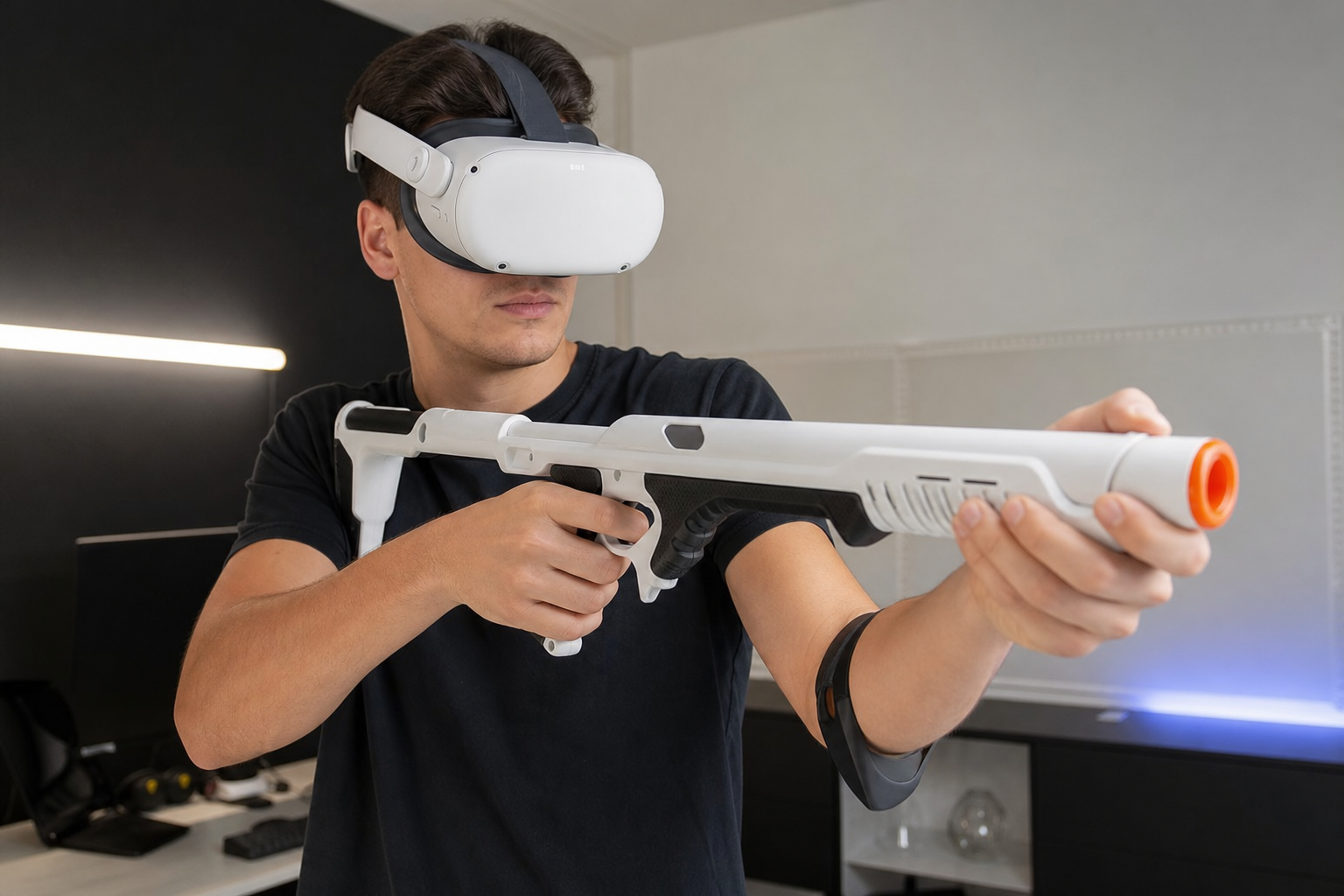
I learned this the hard way. My experience with a gunstock on the Quest 2 was a mix of amazing and frustrating. When I was facing forward and engaging targets, the stability was incredible. My performance in games like Pavlov and Onward shot up. The problem appeared when I had to react quickly. If an enemy flanked me, I would spin 180 degrees. In that motion, my body would sometimes block the headset's view of my front (left) controller, which was locked into the stock. The in-game gun would either freeze or fly off in a random direction for a split second. That split second was often enough to get me eliminated. This is a specific weakness of the Quest 2's tracking ring design. The Quest 3’s Touch Plus controllers don’t have the rings, so they are less likely to get occluded in the same way. The gunstock highlighted the limits of my headset's hardware, proving that compatibility is more than just whether the controllers fit.
Where does whether the stock hits the headset during close aiming show up during real play?
You need to aim down your sights for a precision shot. But as you raise the stock, the cheek rest collides with your headset, throwing off your aim and breaking the illusion.
This happens most often in close-quarters combat. When an enemy pops out from behind a corner, your instinct is to snap the gun up to aim down sights. With a bulky gunstock, you physically can't without the stock hitting the headset, forcing you to hip-fire instead.
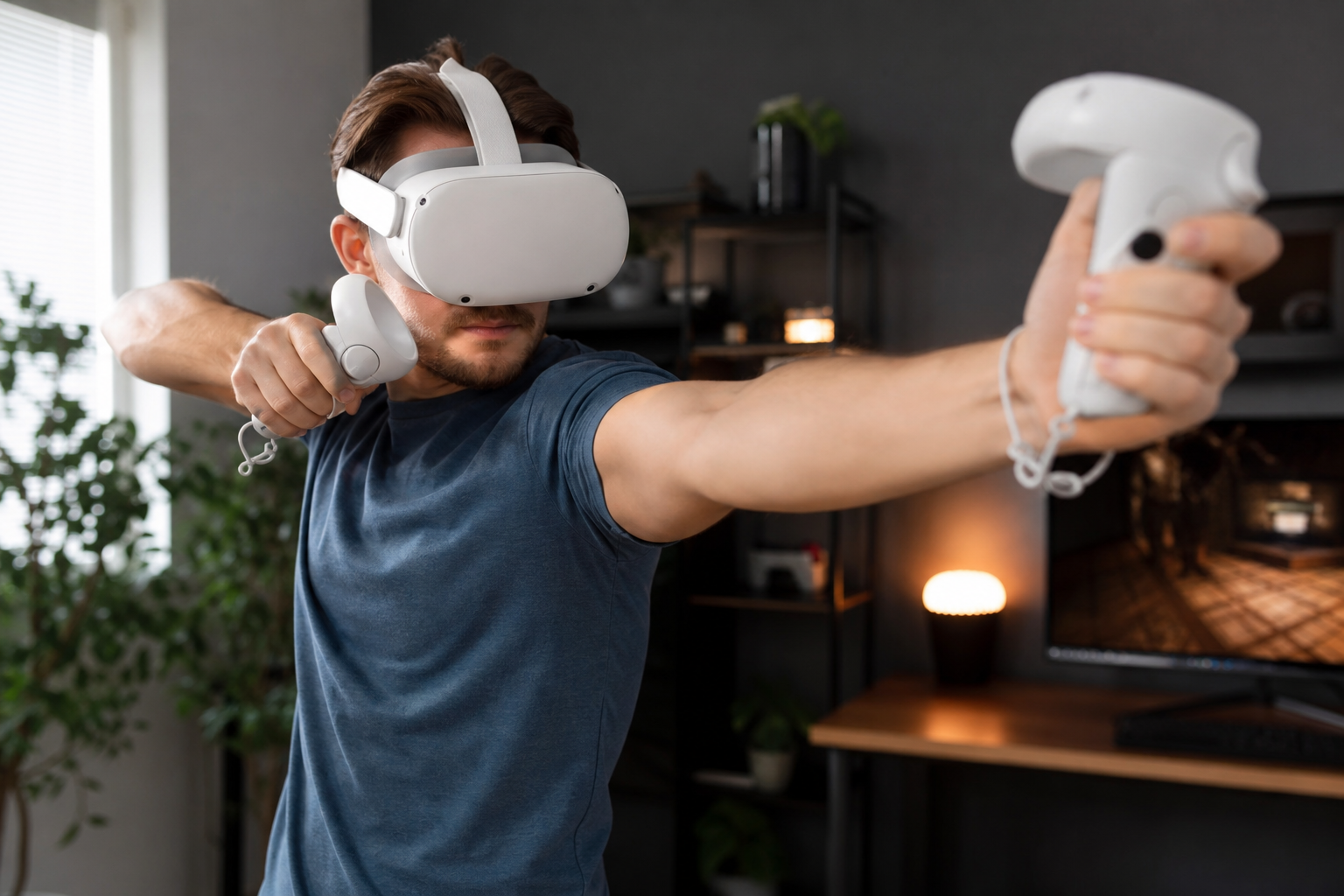
During a tense round of Contractors, I was clearing a building. I knew an opponent was in the next room. I hugged the wall, ready to peek the corner. As I leaned out, I tried to bring my sights up for a clean headshot. Clack. The butt of the gunstock hit the bottom of my Quest 2. My view was jolted, and my aim was completely thrown off. I had to awkwardly crane my neck and re-aim, giving my opponent the time to react and take me down. This isn't just a minor annoyance; it's a real gameplay disadvantage. It forces you to change how you play, making you avoid aiming down sights in tight spaces. Adjustable stocks can help a little by letting you change the angle, but the fundamental problem remains: you're trying to put a physical object where a virtual one should be, and sometimes there just isn't enough space between your chin and your shoulder.
Does the final advice change for shared headsets, kids, or small rooms during tactical VR shooters?
You bought a gunstock for yourself, but now your partner or kid wants to play. Or maybe you just play in a small office. Is the accessory still a good idea?
Yes, the advice changes completely. A gunstock is a personal, single-user device that requires a lot of space. It's difficult to share, potentially unsafe for kids, and a real hazard in a small room where you can easily hit walls or furniture during fast turns.
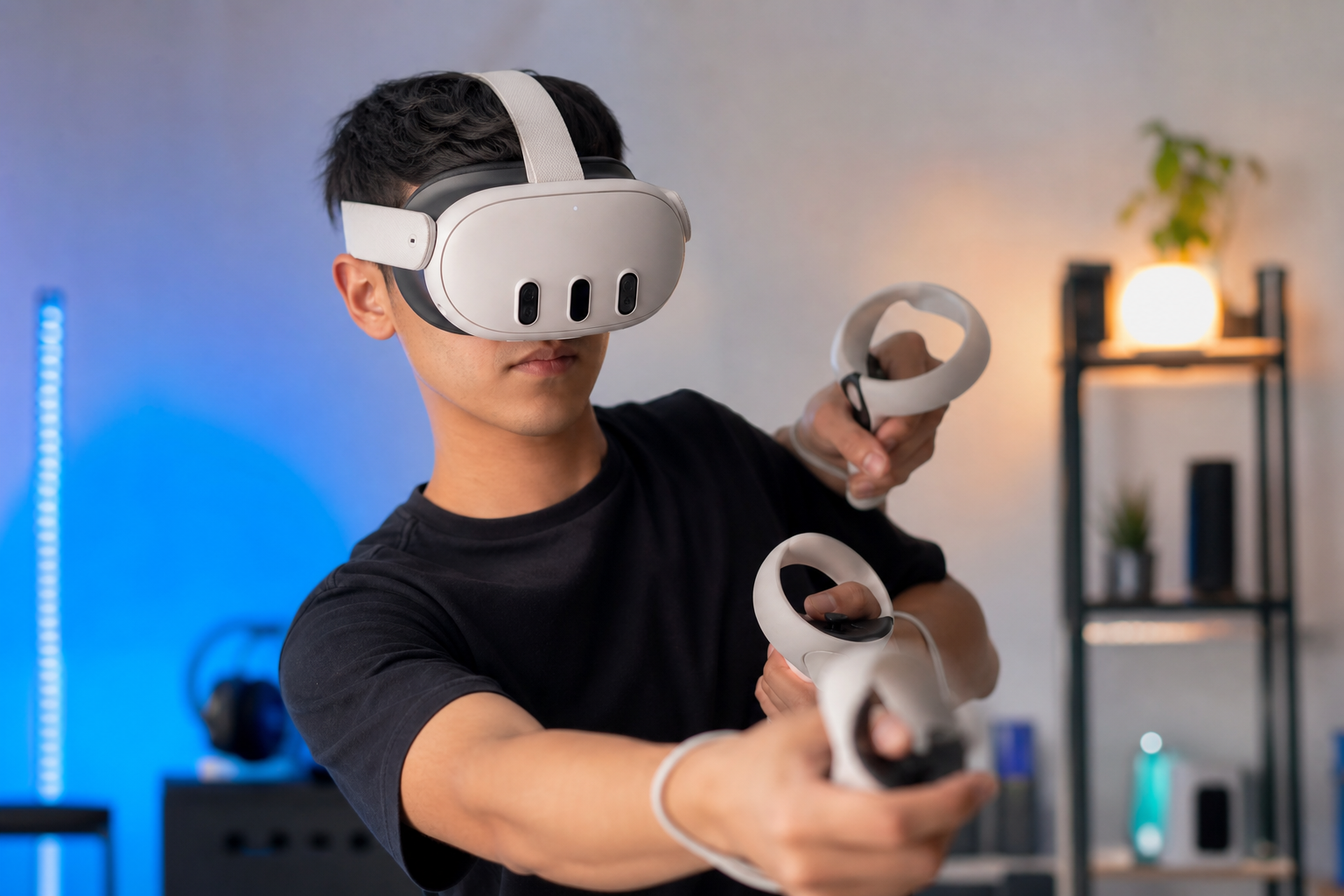
My VR setup is in my home office, which isn't very big. With the gunstock, I suddenly became very aware of my desk and a nearby bookshelf. While testing, I did a quick turn to shoot a target behind me and felt the barrel of the stock scrape against the wall. It was a jarring, immersion-breaking moment. This is the failure case. The gunstock didn't just solve my calibration issues; it created a new set of physical ones. It's not an accessory you can just hand to a friend, as you'd need to readjust all the straps and mounts for their arm length. And I would never give it to a child. The added length and weight make it an accident waiting to happen in an enclosed space. My final verdict has to account for these real-world limits.
Here's my buy-or-skip verdict based on game type and user.
Verdict: Buy or Skip?
| Scenario | Verdict | Reason |
|---|---|---|
|
Serious Tactical Shooter Player (Pavlov, Onward, Contractors) |
Buy | The stability and muscle memory it provides are a huge competitive advantage. You will learn to work around the physical limitations. |
|
Casual or Arcade Shooter Player (Population: One, After the Fall) |
Skip | These games require fast, free movement. A gunstock is too slow and restrictive. It makes actions like climbing and throwing grenades feel clumsy and annoying. |
| Shared Headset Household | Skip | The constant need to readjust the stock for different users makes it more trouble than it's worth. It kills the "pick up and play" nature of VR. |
| Player with a Small Room | Skip | You will hit things. The risk of breaking a controller, your TV, or the stock itself is too high. It creates more stress than immersion. |
Conclusion
A VR gunstock helps serious tactical players gain control but is a clumsy burden for casual games, shared use, or small spaces. It isn't a universal solution for aiming problems.
Leave a comment